





Discover how molecular tools are improving bioinput quality assurance and supporting innovation in sustainable agriculture.
By: Camila Andrade, Project Coordinator, Agronômica
The bioinput market has experienced significant growth in recent years, driven by the pursuit of more sustainable agricultural systems, the need to reduce dependence on chemical inputs, and the increasing demand for food produced with a lower environmental impact. In this context, microorganisms such as beneficial bacteria and fungi have played a key role in plant health management and plant growth promotion.
However, as the sector evolves, so does the need to ensure the identity, purity, viability, and efficacy of commercially available biological products. It is within this context that molecular biology has become a strategic tool, connecting laboratory research with practical applications in the field.
The Challenge of Ensuring Bioinput Quality
The effectiveness of a bioinput is directly related to the quality of the microorganism present in its formulation. The correct identification of the microorganism is one of the fundamental requirements for bioinput development and quality control.
Traditionally, microorganism characterization has been based primarily on morphological, cultural, and biochemical analyses. Although these methods remain important, they often have limitations when distinguishing genetically closely related organisms, particularly at the strain level, or when detecting contaminants present at low concentrations.
Molecular techniques have emerged as a more accurate, rapid, and reliable solution for meeting the sector’s quality and traceability requirements.

The Revolution in Molecular Identification
One of the main contributions of molecular biology to the bioinput production chain is the accurate taxonomic identification, at the strain level, of microorganisms used as active ingredients. By sequencing specific genetic regions, it is possible to confirm the identity of bacteria and fungi with a high degree of reliability.
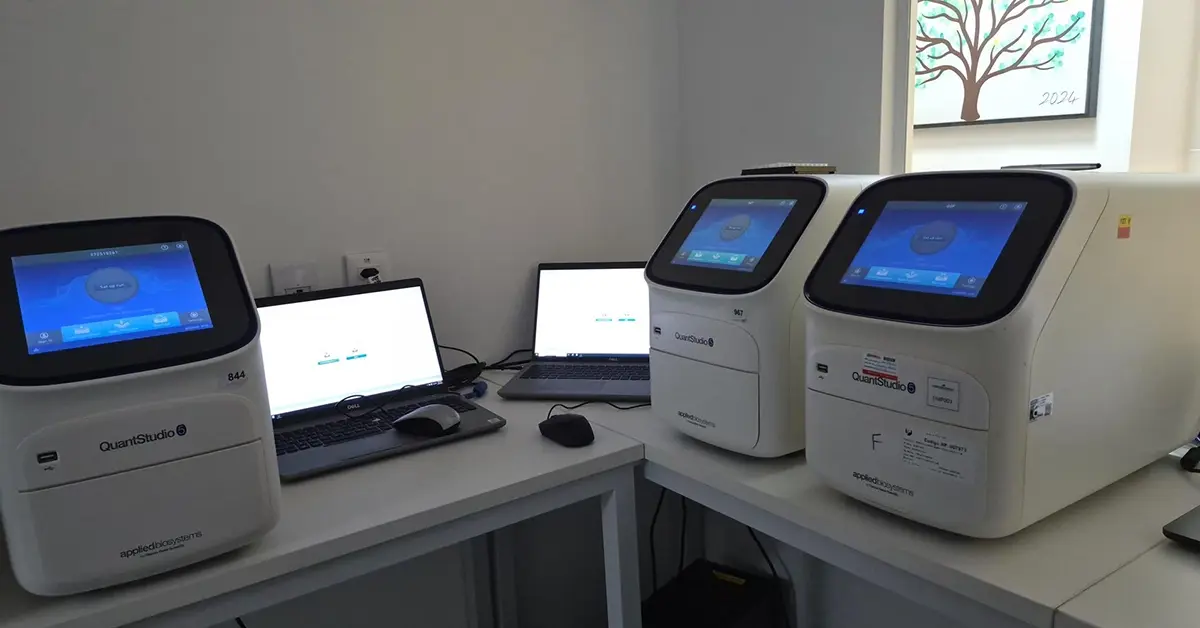
Techniques such as PCR, real-time PCR (qPCR), Sanger sequencing, and next-generation sequencing (NGS) can differentiate species and/or strains that exhibit similar morphological characteristics but have distinct biological behaviors. In some cases, a single genetic marker is sufficient to accurately identify the genus or species. In others, a multilocus approach or even whole-genome sequencing may be required to achieve strain-level resolution.
This level of accuracy is particularly relevant for companies seeking regulatory approval, intellectual property protection for microbial strains, and the standardization of production processes.
Quantification of Viable Microorganisms by PMA-qPCR
Another important advancement is related to the quantification of viable biological agents. While traditional microbiological methods frequently rely on counting colony-forming units (CFU) on culture media, molecular techniques allow for the rapid and highly sensitive estimation of the amount of genetic material present in a sample.
For example, qPCR enables the detection and estimation of a specific genetic target, including in matrices where microbiological isolation may be time-consuming or technically challenging. In formulations containing different species and strains, microorganisms may exhibit different growth rates, nutritional requirements, and tolerances to the culture medium.
When plate-count methods are used alone, fast-growing microorganisms may hinder the recovery of other microorganisms of interest in the product. Closely related species may also produce visually similar colonies. Therefore, target-specific molecular assays can enable the individual detection of each microorganism present in the formulation. However, this application requires the careful development of a specific protocol capable of demonstrating that no cross-reactivity occurs among the strains present in the product.
For the quantification of viable cells by qPCR using propidium monoazide (PMA), a photoreactive dye used to differentiate viable from nonviable cells, several factors must be evaluated. These include the number of target copies in the genome, DNA extraction efficiency, genetic material recovery, matrix effects, and the working range of the assay.
Without these controls, the estimate may not accurately represent the concentration of the microorganism in the product. Rather than simply performing PMA-qPCR or obtaining a sequence, the laboratory must demonstrate that the method is fit for its intended purpose.
This includes the use of positive and negative controls, acceptance criteria, inhibition assessment, reagent traceability, equipment monitoring, and complete analytical records. Confidence in the results depends not only on the method itself, but also on the technical competence, infrastructure, and quality management system supporting its implementation.
The study reported by Cap et al. (2025) described the first application of PMA-qPCR for the quantification of viable cells of Bradyrhizobium diazoefficiens strain 5080 in inoculants. The authors highlighted its potential as a high-throughput tool for improving the efficiency and accuracy of industrial quality control across product batches.
Support for Regulatory Processes
With the advancement of regulations governing biological products, particularly following the publication of the Bioinput Methodology Manual by the Brazilian Ministry of Agriculture and Livestock (MAPA) in 2025, the validation of molecular methods has become increasingly important for obtaining product registrations from the relevant regulatory authorities.
Laboratório Agronômica’s expertise in analytical method validation and qPCR enables the laboratory to contribute technical knowledge and generate scientific evidence to support product registration processes before MAPA.
However, the use of qPCR requires rigorous validation. Parameters such as specificity, selectivity, amplification efficiency, linearity, precision, repeatability, reproducibility, limit of detection, and limit of quantification must be evaluated.
The future of bioinput analysis lies in the integration of classical microbiology, molecular biology, genomics, bioinformatics, and agronomic testing. When these approaches are used in a complementary manner, it becomes possible to transform a promising microorganism into a more reliable, traceable, and technically consistent product.
Discover Agronômica's Specialized Solutions
📩 Need specialized laboratory support for your bioinput projects? Contact Agronômica at comercial@agronomicabr.com.br and discover our analytical solutions.
Reference
Cap M, Frydman C, Galiñanes A, Aranguiz C, Faraco I, Andriolo L, et al. (2025) PMA-qPCA: Accelerating the market release of high-quality Bradyrhizobium diazoefficiens inoculant | PLOS One
About Agronômica
AGRONÔMICA is a leading phytosanitary diagnostics laboratory in Brazil, offering integrated solutions that support decision-making by key players in the agricultural sector. We operate in all stages of the agribusiness chain, with services that include the identification of regulated and restrictive pests, by national requirements and international agreements; disease diagnosis and identification of beneficial microorganisms; analysis of biological products and inoculants; efficacy and compatibility testing of chemical and biological pesticides, both under controlled conditions and in the field; as well as physical-chemical and microbiological analyses. All these services are aligned with our commitment to plant health, sector sustainability and the promotion of food security.